








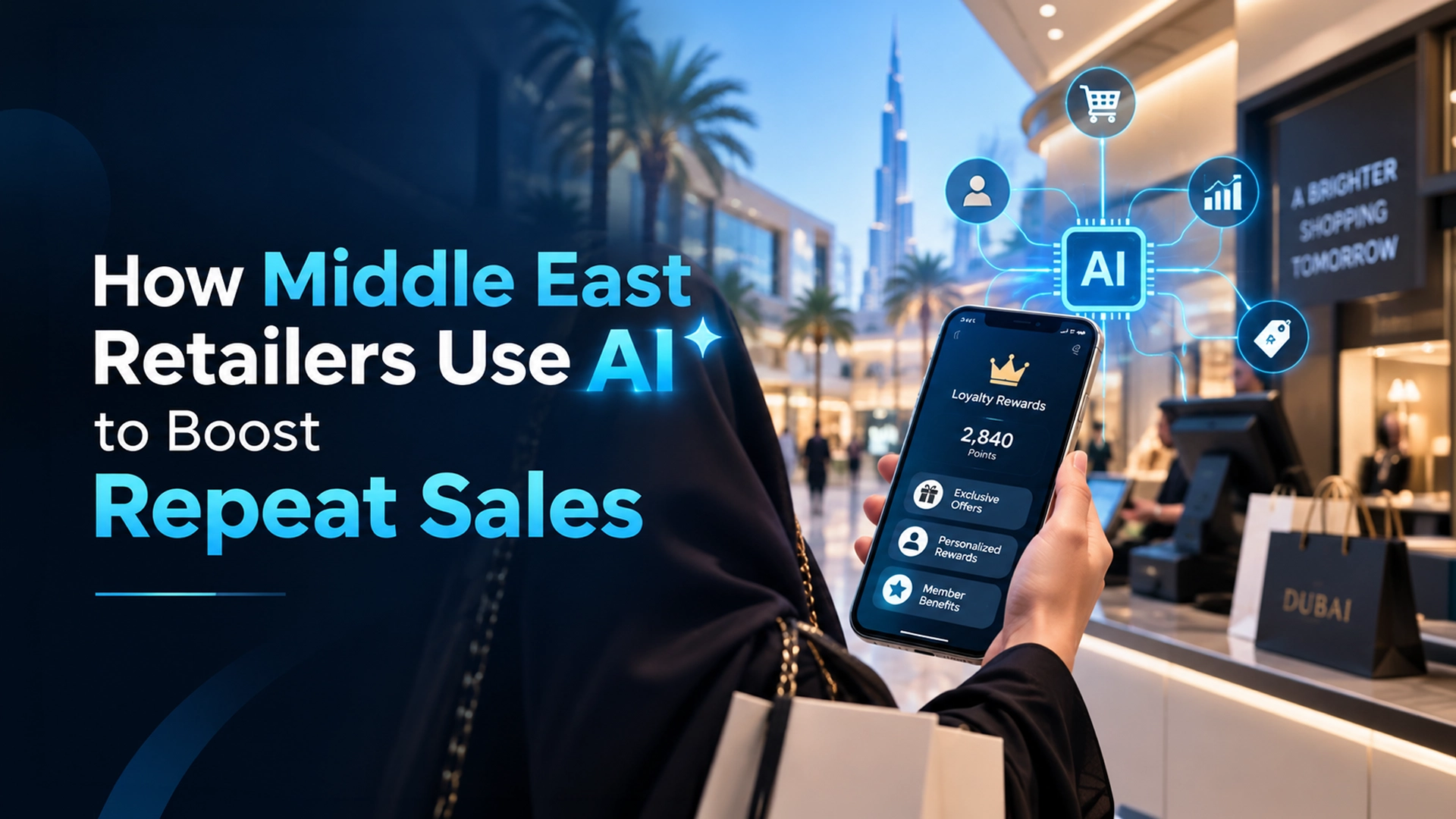
Walk through a mall in Dubai or Riyadh and you’ll notice something: nearly every major retailer now has a loyalty app on the screen at checkout. This isn’t a coincidence or a trend that arrived from elsewhere and got copied locally. The Middle East has become one of the most loyalty-program-saturated retail markets in the world, and the reasons are specific to how the region shops, spends, and engages with brands.
What’s changed more recently is the sophistication behind these programs. The first generation of Gulf loyalty programs were simple points-for-purchases mechanics — useful, but generic. The current generation is increasingly AI-powered: predicting which reward will actually motivate a specific customer, identifying who’s about to churn before they do, and personalising offers at a level that flat, one-size-fits-all programs never could.
This piece looks at why this shift matters specifically for Middle East retailers, what AI-powered loyalty actually does differently, and how smaller and mid-size retailers — not just the regional giants — can apply the same principles without an enterprise budget.
Why Loyalty Programs Carry More Weight in This Region
A few structural factors make loyalty programs unusually effective across the GCC compared to many other retail markets.
High smartphone and app engagement. The region has some of the highest smartphone penetration and app usage rates globally, meaning a loyalty program delivered through an app or WhatsApp reaches customers where they already spend their time, rather than competing for attention through a channel they rarely check.
Strong cultural value placed on relationship and recognition. Regional consumer behaviour places real weight on feeling recognised and valued by a brand, not just transacted with. A loyalty program that genuinely personalises — remembering preferences, anticipating needs, rewarding in ways that feel relevant rather than generic — taps directly into this expectation.
Seasonal spending spikes that reward retention investment. Ramadan, Eid, and major sale events drive concentrated bursts of spending. Retailers with an engaged loyalty base going into these periods consistently see stronger results than those relying purely on broad discounting to drive seasonal traffic, because loyal customers convert faster and spend more per visit without needing the same depth of discount.
Rising customer acquisition costs across digital channels. As more regional retailers compete for the same digital ad inventory, acquisition costs have climbed steadily. Retention has become the more economical lever, and loyalty programs are the primary mechanism for pulling it — a pattern Bain & Company’s customer loyalty research has documented across retail markets globally, where a small lift in retention typically drives a disproportionately larger lift in profit. This can also complement broader initiatives like a customer referral program, which converts loyal shoppers into a source of new customers.
What “AI-Powered” Actually Means Here
The term gets used loosely. Stripped of buzzwords, AI-powered loyalty typically means a handful of specific, practical capabilities.
Predicting which reward actually motivates a given customer
Not every customer responds to the same incentive. Some are motivated by a straightforward discount. Others respond more strongly to early access, free shipping, or a tangible gift. By analysing past redemption behaviour, AI-driven systems can predict which reward type is most likely to drive action for a specific customer segment — or even an individual customer — rather than offering the same generic 10%-off to everyone.
Identifying churn risk before it happens
Customers rarely churn without warning signs — a lengthening gap between purchases, declining basket size, reduced app engagement. Machine learning models trained on purchase history can flag these patterns early enough for a retailer to intervene with a targeted offer, rather than discovering the customer is gone only when they’ve been silent for months.
Dynamic tier and reward adjustment
Rather than static VIP tiers based purely on cumulative spend, more sophisticated programs adjust dynamically based on recent behaviour, engagement trends, and predicted lifetime value — recognising and rewarding customers who are accelerating their engagement, not just rewarding historical spend that may no longer reflect current behaviour.
Personalised timing, not just personalised content
AI-driven send-time optimisation determines when a specific customer is most likely to engage with a message — which, for a region with distinct daily rhythms around prayer times, work schedules, and evening social patterns, has a measurable effect on open and redemption rates compared to a single blanket send time for the entire customer base.
AI Loyalty Programs Aren’t Only for Enterprise Retailers
It’s easy to assume this level of sophistication requires an enterprise data science team and a seven-figure martech budget. That assumption was more true a few years ago than it is now.
The current generation of loyalty and CRM platforms increasingly embed these AI capabilities directly into the product rather than requiring custom data science work — meaning a mid-size retailer with a few thousand active customers can access churn prediction, reward personalisation, and send-time optimisation through configuration rather than custom engineering.
What this requires from the retailer’s side is less about budget and more about data discipline: consistent customer identification across channels (in-store and online purchases tied to the same customer profile), enough transaction history for patterns to emerge, and a willingness to act on the system’s recommendations rather than just collecting the data passively.
A Practical Starting Point
For a mid-size retailer not yet running a sophisticated program, the realistic sequence looks like this:
- Unify customer identity first. If in-store and online purchases aren’t tied to the same customer record, fix this before anything else — every subsequent capability depends on a complete view of each customer’s behaviour.
- Launch a straightforward points and tier structure. Get the basic mechanic live and generating data before layering in personalisation — you need behavioural history before AI-driven recommendations have anything meaningful to learn from.
- Add WhatsApp as the primary engagement channel. Given regional messaging habits, integrating loyalty communication through WhatsApp rather than email alone significantly improves engagement rates — see our guide to WhatsApp business automation for how this works in practice.
- Introduce churn prediction and personalised offers once you have 6+ months of data. These capabilities work best with enough historical behaviour to learn from — attempting this too early with limited data produces unreliable recommendations.
Frequently Asked Questions
How much customer data do we need before AI-driven personalisation becomes useful?
As a general guideline, most predictive models become meaningfully accurate after a retailer has accumulated at least a few months of consistent transaction history across a base of a few thousand active customers. Smaller or newer programs can still run effective loyalty mechanics — they simply rely more on straightforward rules-based personalisation until enough data accumulates for predictive models to add real value.
Does this require building custom AI models from scratch?
For most retailers, no. Many modern loyalty and CRM platforms include these capabilities as built-in features rather than requiring custom model development. Custom AI development becomes relevant for larger retailers with very specific behavioural patterns that off-the-shelf models don’t capture well, or where the loyalty program needs deep integration with proprietary inventory or pricing systems.
How does this work for retailers selling both online and in physical stores?
Omnichannel identity resolution — recognising the same customer whether they’re shopping in-store or online — is the foundation this entire approach depends on. This typically requires integrating point-of-sale data with online customer accounts, often through a unified customer ID tied to a phone number or loyalty card, which is the most common identifier used across both channels in this region.
Is WhatsApp integration necessary, or is app/email sufficient?
Given regional engagement patterns, WhatsApp typically significantly outperforms email for loyalty communication in this market. It isn’t strictly necessary, but retailers who skip it are generally leaving meaningful engagement on the table compared to those who use it as a core channel.
Building Loyalty That Actually Recognises Your Customers
The retailers pulling ahead in this region aren’t necessarily spending more on loyalty — they’re spending it more intelligently, on programs that recognise individual customers rather than treating the entire base identically. That shift is increasingly accessible to mid-size retailers, not just the largest regional chains.
Luminous Labs works with Middle East retailers to build and integrate loyalty programs — including WhatsApp-native engagement through TextCRM — designed around how customers in this market actually shop and engage. Book a free discovery call to talk through what a practical starting point looks like for your specific customer base.
Luminous Labs is an independent software development and consulting company serving retail and e-commerce businesses across the Middle East, UK, US, and Australia since 2017.