









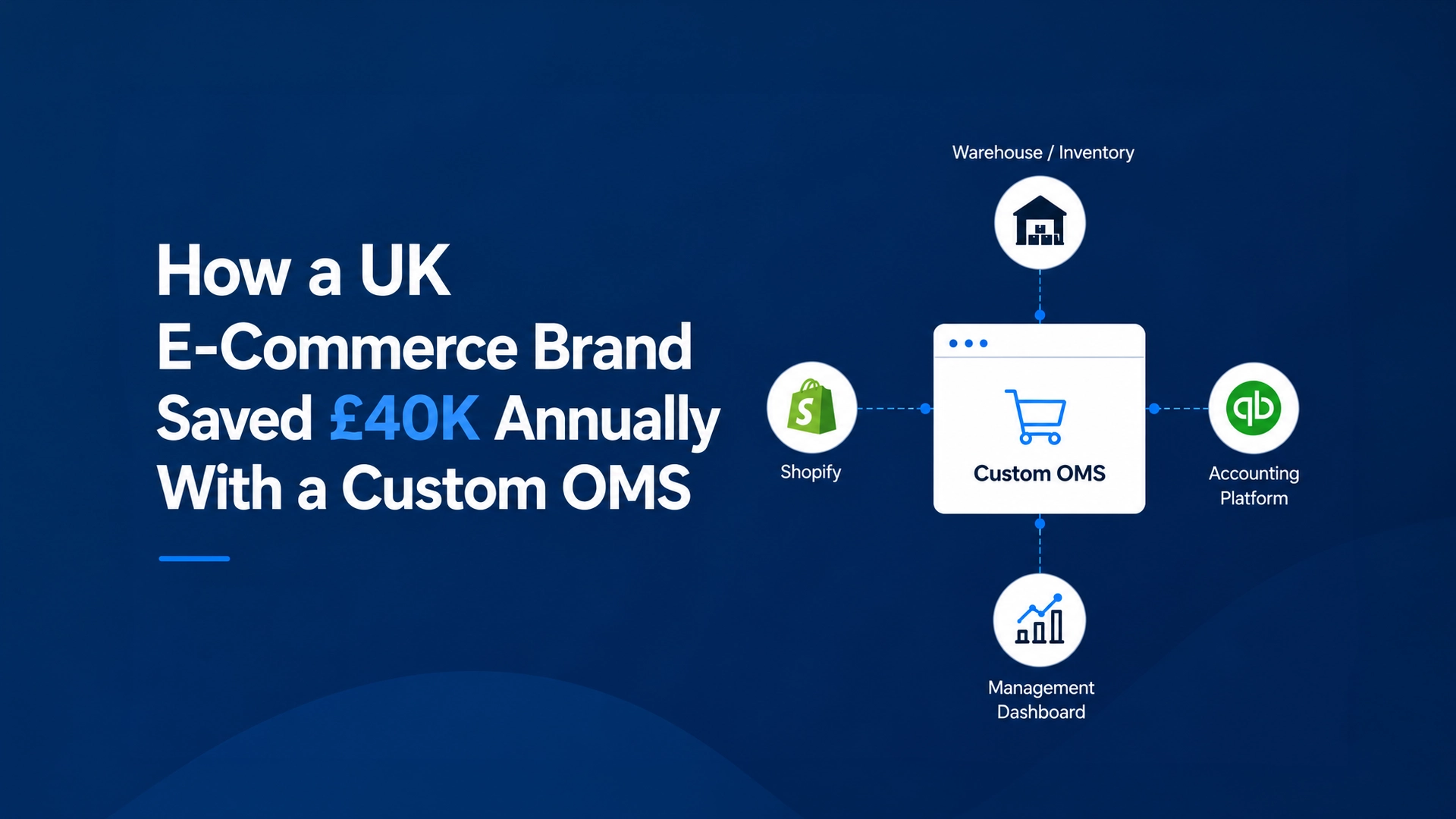
Custom OMS Case Study: Most case studies in this industry are written to flatter the agency. This one is written to be useful, which means it includes the parts that didn’t go perfectly along with the parts that did.
A UK-based e-commerce brand selling specialty home goods came to us with a problem that’s extremely common but rarely discussed openly: their order management was being run across three disconnected systems, held together by a small operations team manually re-keying information between them every single day.
This is a composite case study built from a representative engagement pattern we see regularly with UK e-commerce clients. Specific figures are illustrative of typical outcomes for businesses in this situation. We’re publishing it as a framework for diagnosing whether your business has the same underlying problem — because the pattern matters more than any single company’s numbers. If you want the more general version of this decision, our guide to the signs your business needs an ERP covers the broader diagnostic.
The Starting Point
The business was running a Shopify storefront for online orders, a separate inventory spreadsheet maintained by the warehouse team, and a third-party accounting platform for invoicing and financial reporting. None of these systems talked to each other automatically.
The daily reality looked like this: a customer places an order on Shopify. Someone on the operations team checks the spreadsheet to confirm stock. If stock is available, they manually update the spreadsheet, generate a picking list, and separately create an invoice in the accounting platform. If a SKU was oversold because the spreadsheet hadn’t been updated in time, the team discovered the problem only after the customer had already been charged — triggering an apologetic email, a refund or backorder conversation, and real reputational cost.
The operations team — two people — were spending an estimated 25–30 hours per week collectively on this manual reconciliation work. Stock discrepancies were causing 15–20 oversold incidents per month. Month-end financial close regularly took the finance lead the better part of a week, because invoice data, order data, and inventory adjustments all had to be manually cross-checked before the numbers were trusted.
The Custom OMS We Actually Built
Rather than replacing Shopify — which the business liked and which their customers were already familiar with — we built a custom Order Management System (OMS) that sat in the middle, connecting Shopify, the warehouse inventory process, and the accounting platform into a single, automatically synchronised flow.
The core of the build:
- Real-time inventory sync between Shopify and a proper inventory database, replacing the manually updated spreadsheet entirely. Stock levels updated the instant an order was placed, a return was processed, or new stock arrived.
- Automated invoice generation that created and pushed invoices to the accounting platform the moment an order was confirmed, eliminating manual re-entry and the lag between sale and recorded revenue.
- A warehouse-facing interface replacing the spreadsheet with a simple, purpose-built tool for picking, packing, and stock adjustments — designed for speed on a warehouse floor, not a desk-based spreadsheet workflow.
- A management dashboard giving the founders real-time visibility into orders, stock levels, and revenue without needing anyone to assemble a report.
We deployed this in three phases over roughly 14 weeks: inventory sync and warehouse tool first (the highest-friction problem), automated invoicing second, and the management dashboard last — once the underlying data was reliable enough for a dashboard to be trustworthy.
What Didn’t Go Smoothly?
Worth being honest here. The original inventory spreadsheet had years of inconsistent SKU naming and several thousand rows of stale or duplicate entries. The data cleanup required before the sync could go live took longer than originally scoped — roughly three additional weeks — because the warehouse team needed to physically verify stock counts against the system as part of the migration. This is an extremely common underestimation in projects like this, and we now build a more conservative data-cleanup buffer into every OMS scoping conversation as a direct result.
The warehouse team also needed more hands-on training than anticipated on the new interface, since the previous spreadsheet process — however inefficient — was deeply familiar. A planned one-day training session became a week of light-touch support during the transition.
The Outcome
Within the first full quarter of operating on the new system:
- Oversold incidents dropped from 15–20 per month to fewer than 2, directly reducing refund costs, customer service overhead, and the reputational cost of broken promises to customers.
- The operations team’s manual reconciliation work dropped from roughly 25–30 hours per week to under 5, freeing capacity that was redirected to customer service and supplier relationship management rather than data entry.
- Month-end financial close shortened from most of a week to roughly a day and a half, because the numbers were already reliable and synchronised rather than needing manual cross-checking.
- Annualising the recovered staff time plus the reduction in refund and reshipping costs from oversold orders put the business’s total savings in the region of £35,000–£45,000 per year — comfortably justifying the project investment within the first 12 months.
Why This Pattern Is So Common?
This is not an unusual situation. It’s close to the default state for e-commerce businesses that have grown past their first year or two of operation. The tools that worked perfectly well at low order volume — a spreadsheet, a basic accounting tool, manual processes bridging the gaps — start breaking down as order volume increases, not because the team got worse at their jobs, but because manual processes have an error rate that scales with volume.
The signal worth watching for in your own business: if your team is manually re-entering the same piece of information — an order, a stock count, a customer detail — into more than one system, you are paying an ongoing cost for that gap whether or not it shows up as a clear line item anywhere. The same logic, including the cost comparison against off-the-shelf alternatives, is laid out in our guide to custom software vs. SaaS.
Custom OMS Case Study – Frequently Asked Questions
1. Do we need to replace our existing e-commerce platform to fix this kind of problem?
Usually not. In most cases, the e-commerce front end — Shopify, WooCommerce, or similar — is working fine for customers. The problem is almost always in the disconnected back-office systems behind it. A custom OMS layer that integrates with your existing storefront is typically far less disruptive and less expensive than replacing the storefront itself.
2. How do we know if we need a custom OMS versus an off-the-shelf one?
Off-the-shelf OMS products work well when your fulfilment process is fairly standard. Custom builds make more sense when your business has distinctive processes — specific packaging requirements, unusual supplier relationships, a particular warehouse layout — that off-the-shelf products require significant workarounds to accommodate.
3. How long does a project like this typically take?
For a mid-size e-commerce business, a phased OMS build typically takes 10–16 weeks from discovery to full deployment, depending on the state of existing data and the number of systems being integrated. Phasing the rollout — tackling the highest-friction problem first — means the business starts seeing value before the entire project is complete.
Recognise This Pattern in Your Own Business?
If your team is bridging gaps between systems manually — re-entering data, cross-checking spreadsheets, discovering stock problems after a customer has already been charged — that’s solvable, and usually faster and less expensive than business owners expect. If your wider operations need the same diagnosis applied beyond order management, our UK SME digital transformation guide covers where to start and what it costs.
Luminous Labs runs a free discovery session where we map your current order and inventory flow and give you an honest view of where the friction is and what fixing it would cost. Book your call here.
Luminous Labs is an independent software development and consulting company serving UK, US, Middle Eastern, and Australian e-commerce businesses since 2017.