






10 Signs You Need a Custom ERP: Most businesses don’t decide they need an ERP. They realise they needed one six months ago.
By the time the pain becomes undeniable, reports taking three days to compile, inventory mismatches showing up in customer orders, finance and operations working from different versions of the truth — the organisation has already absorbed a significant operational cost in manual workarounds, corrected errors, and management time spent reconciling data that should have been automatically consistent.
Enterprise Resource Planning systems exist to solve this exact class of problem. But “ERP” is a term that means different things at different scales, and the decision to implement one, or to build a custom one rather than buying a packaged product — deserves more precision than it typically gets.
This guide walks through the ten clearest signals that a business has outgrown its current systems and should be evaluating an ERP, why those signals matter, and what the decision looks like in practice.
What a Modern ERP Actually Does?
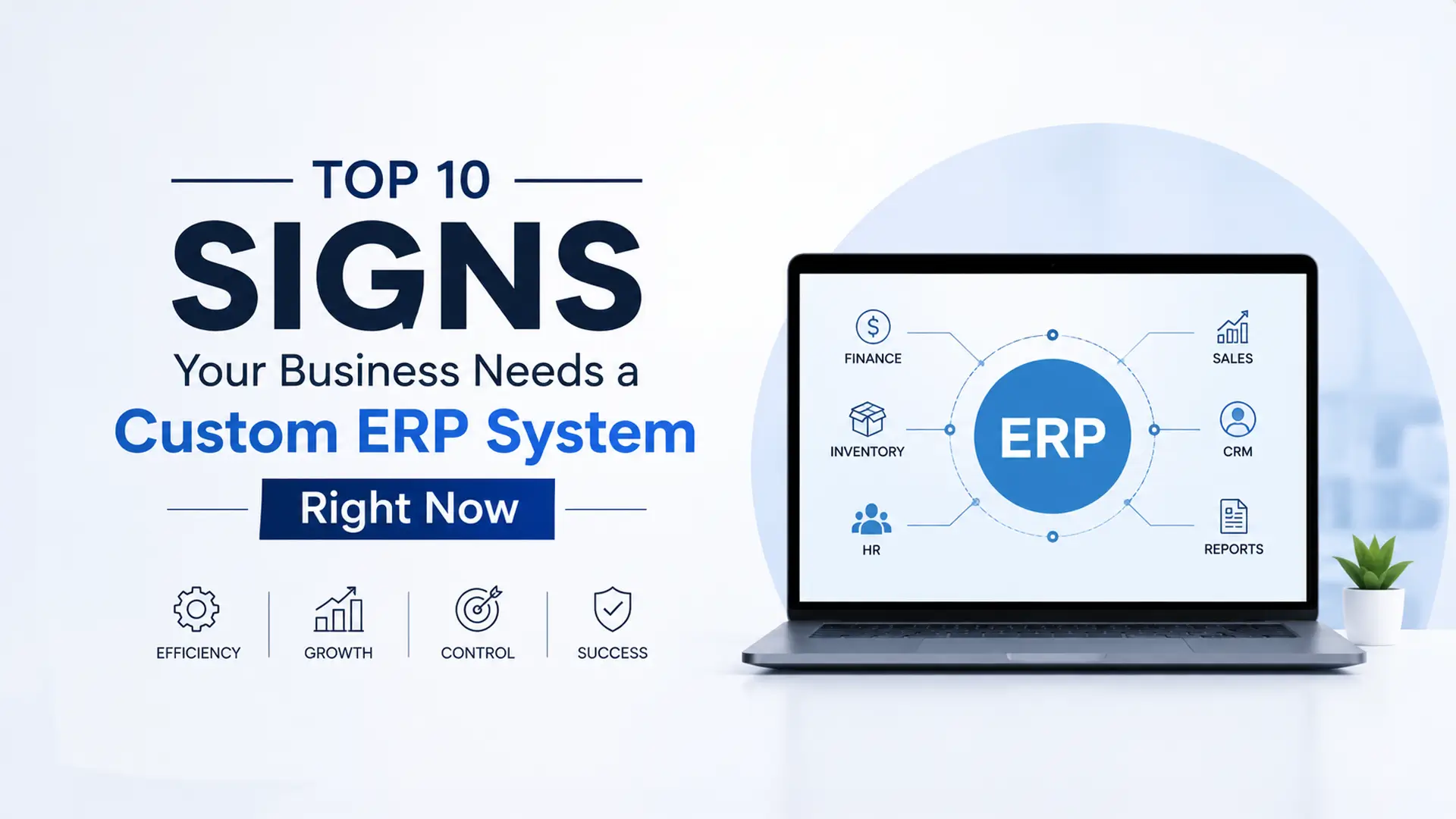
An ERP is not a single application — it’s an integrated system that connects the core operational functions of a business into a unified data environment. Depending on the modules implemented, this typically includes inventory management, procurement, order management, finance and accounting, human resources, customer management, production or service delivery, and reporting.
The defining characteristic is the single source of truth: when a sale is recorded in the system, it simultaneously updates inventory, triggers the accounts receivable workflow, adjusts the fulfilment queue, and reflects in management reporting — without anyone manually copying data between systems or running nightly reconciliation scripts.
For businesses that have been running on a combination of disconnected tools and spreadsheets, this integration is not a nice-to-have. It’s the difference between running a business on current information or running it on information that’s always slightly wrong.
10 Signs Your Business Needs a Custom ERP System
1. Your data lives in too many places
Customer records in a CRM. Inventory in a spreadsheet. Orders in an e-commerce platform. Invoices in accounting software. Purchase orders tracked in email threads.
When each function of your business maintains its own data in its own system, every cross-functional decision requires someone to manually pull from multiple sources and hope they’re looking at the current version. The probability of error compounds with every step in that process.
If answering a simple question like “what’s our current margin on this product after fulfilment costs?” requires touching four different systems, you have a data integration problem that an ERP resolves at the architecture level.
2. You’re running important processes in spreadsheets
Spreadsheets are remarkable tools. They’re also the most common sign that a business has outgrown its software.
When spreadsheets become the operating layer for inventory management, project tracking, staff scheduling, customer orders, or financial reporting, the business is paying a hidden cost: manual data entry errors, version control problems, no audit trail, no real-time visibility, and a single person who “owns” the spreadsheet and becomes a bottleneck whenever they’re unavailable.
These are not problems that can be solved by building a better spreadsheet. They require a system.
3. Closing the books takes more than a week
In a well-integrated business, month-end close is a mechanical process that takes a day or two — the numbers are already in the system, the reconciliations are largely automated, and the work is verification rather than assembly.
When closing the books takes a week or more, it’s almost always because someone is manually assembling data from multiple sources. Finance teams that spend most of month-end doing data collection rather than financial analysis are operating below their actual function. The cost is both operational — their time — and strategic — management making decisions on financial information that’s always a month behind.
4. Inventory accuracy is a persistent problem
For any business that holds physical stock, inventory inaccuracy is one of the most expensive operational problems to ignore.
Overselling items you don’t have damages customer relationships. Overstocking items that aren’t selling ties up working capital. Shrinkage you can’t identify or attribute creates unexplained margin erosion.
These problems typically have one root cause: inventory data is updated manually, in batches, by people who are also doing other things. An ERP with integrated inventory management updates stock levels in real time across every transaction — sales, returns, purchases, adjustments, production — so the number in the system reflects reality within the same business day.
5. You can’t see the business clearly in real time
When a business leader has to wait for the weekly report, or ask someone to pull the numbers, or assemble data from multiple dashboards before they can understand how the business is performing — they’re making decisions with delayed information.
The cost of this is not always obvious until a decision goes wrong that better information would have prevented. An ERP provides a live operational view: current order volume, current fulfilment status, current cash position, current margin by product or service line — available without anyone having to run a report.
6. Onboarding new staff takes too long because knowledge lives in people, not systems
In businesses that have grown organically around informal processes and tribal knowledge, onboarding a new operations hire means pairing them with a senior person for weeks to teach them the manual workflows, the undocumented exceptions, the naming conventions in the spreadsheets.
An ERP encodes the business logic in the system itself. New staff learn a consistent process defined in the software rather than inheriting the personal habits of whoever trained them. This makes scaling headcount faster, reduces variability, and means the business is less dependent on specific individuals.
7. Customer-facing errors are increasing with scale
Late deliveries. Wrong items shipped. Invoices with incorrect amounts. Promises made by sales that operations doesn’t know about. Support tickets for issues that should have been caught in the fulfilment process.
When these errors are isolated incidents, they’re operational problems. When they track the growth of the business — increasing roughly in proportion to order volume — they’re a system architecture problem. The manual processes that worked at 20 orders per day don’t work at 200 orders per day, not because people are working less carefully, but because the error rate of any manual process scales with volume.
8. Compliance and audit requirements are straining your current setup
As businesses grow, their compliance environment grows with them. Larger customers require SOC 2 or ISO-level security controls. Export activity triggers customs documentation requirements. Revenue thresholds trigger VAT registration in additional jurisdictions. Sector-specific regulation requires audit trails, retention policies, and access controls.
Spreadsheets and disconnected SaaS tools cannot provide the audit trails, role-based access controls, and documentation workflows that compliance requires. Businesses facing serious compliance obligations typically find they need an integrated system with proper access controls and logging capabilities — which is one of the functions a well-implemented ERP provides.
9. Your current tools are not talking to each other
Many businesses reach a point where they have the right individual tools — a good CRM, a capable e-commerce platform, a solid accounting package — but the connections between them are fragile. A custom integration that worked fine at lower volume is now failing under load. The sync between the sales system and the inventory system runs nightly and is always a day behind. Data that exists in one system has to be manually re-entered into another.
Patching integrations between systems that were never designed to work together is a temporary solution that becomes progressively more expensive to maintain. At some point, replacing the patchwork with a system designed for integration is the right call.
10. Your growth is being constrained by operational bottlenecks
The clearest signal of all: when business development is no longer the constraint on growth, but operations is.
When sales could be higher but the operations team can’t process more orders reliably. When the product could be expanded but there’s no system to manage the additional SKU complexity. When entering a new market is stalled because the current reporting structure can’t handle multi-currency or multi-entity accounting.
These are not hiring problems. Adding people to a broken process makes it a bigger broken process. The right fix is a system that handles the operational complexity so people can work on higher-value activities.
Custom ERP vs. Packaged ERP: Which Path Is Right?
Once the case for an ERP is established, the next decision is whether to implement a packaged ERP product (SAP, Oracle, Microsoft Dynamics, Odoo, NetSuite) or commission a custom-built system.
Packaged ERPs offer breadth, maturity, and faster initial deployment. They’re the right choice when your business processes are reasonably standard for your industry and the implementation effort to configure the platform is less than the effort to build something custom.
Custom ERPs make sense when your operational processes are genuinely distinctive, when packaged products require significant customisation that erodes their advantages, or when you need deep integration with proprietary systems that a packaged product can’t accommodate cleanly. They also make sense when the total cost of ownership over five years is lower than the licensing and implementation cost of a packaged alternative — which is more common than most businesses expect.
There’s also a middle path: building a custom core system that handles the functions most differentiated for your business, and integrating it with best-in-class SaaS products for commodity functions like accounting or HR. The underlying logic is the same one we walk through in detail in our guide to custom software vs. SaaS — it’s the same decision framework, just applied specifically to operations.
10 Signs You Need a Custom ERP – Frequently Asked Questions
1. How much does a custom ERP cost to build?
A focused custom ERP covering core operations for a 20–100 person business typically ranges from $40,000–$200,000 depending on the number of modules, integration complexity, and development approach. Phased implementations — where you build the most critical modules first and expand over time — allow businesses to realise value earlier and manage the investment across budget cycles rather than committing the full amount upfront.
2. How long does an ERP implementation take?
For a custom ERP delivered in phases, the first working modules are typically deployed in 12–16 weeks. A full multi-module implementation for a mid-size business usually takes 6–12 months end-to-end, depending on scope and the organisation’s capacity to participate in requirements definition and testing.
3. Can an ERP integrate with the tools we already use?
Yes — modern custom ERPs are designed with API-first architecture that allows integration with existing tools. Common integrations include accounting platforms, payment gateways, e-commerce platforms, logistics providers, and communication tools. The integration scope is defined during the discovery phase and built as part of the system.
4. What’s the difference between an ERP and a CRM?
A CRM (Customer Relationship Management) system focuses on managing customer interactions, sales pipelines, and customer data. An ERP is broader — it encompasses operations, inventory, finance, procurement, and fulfilment in addition to customer management. Many ERPs include CRM functionality, and many businesses run a CRM as one component of a wider ERP-enabled operations stack.
5. Do small businesses need an ERP?
Not necessarily — and the distinction matters. Businesses under 10–15 employees with simple operations usually don’t need an ERP; the right set of SaaS tools is more appropriate and less costly to implement. The ERP conversation typically becomes relevant when a business has 20+ employees, manages meaningful operational complexity, and is experiencing the specific pain points described above. At that stage, the ROI from reduced manual work, fewer errors, and better management information typically justifies the investment.
What to Do If You Recognise Your Business in This List?
The right first step is not to start evaluating ERP vendors. It’s to map your current situation with enough precision to know what you actually need.
That means understanding which processes are causing the most pain, what data currently lives where, what integrations you need, and what the real operational cost of your current situation is. That diagnostic work takes a few weeks and shapes everything that follows — from whether a custom build or a packaged product is right for you, to what the phasing should look like if you do build custom.
Luminous Labs runs a free technical discovery session for businesses at this decision point. We review your current systems, map where the friction is, and give you an honest assessment of what an ERP would solve and what it would cost — without a sales agenda attached to the answer.
If you decide a custom build is the right path, the team you choose to build it matters enormously. Our guide to hiring a reliable offshore development team covers exactly how to vet a partner before you commit, and you can see the full range of what we build in our custom software development services.
Book your free discovery session here.
Luminous Labs is an independent software development and consulting company based in Dhaka, Bangladesh, delivering custom ERP and business software solutions to clients across Asia, the Middle East, UK, and Australia since 2017.