








VoIP IVR for Business: Every growing business eventually has the same conversation. Customer call volume has crossed a threshold where the current setup a shared mobile number, maybe a basic VoIP plan from a generic provider is visibly straining. Calls get missed. There’s no way to route a call to the right department. Management has no visibility into call volume, wait times, or which calls are converting into business and which aren’t.
The instinct at this point is usually to look for a better off-the-shelf VoIP or call center product. That’s often the right instinct. Sometimes it isn’t. The decision between buying a packaged communication platform and building a custom VoIP/IVR system deserves more thought than it typically gets, because the two paths diverge significantly in cost, flexibility, and long-term fit.
This guide walks through how to actually make that decision, with realistic numbers and the specific signals that point toward one path or the other. The underlying logic mirrors the broader build-vs-buy decision we cover for software generally — it’s the same framework, applied specifically to voice and call handling.
VoIP IVR for Business: What It Actually Means in Practice
VoIP (Voice over Internet Protocol) is the underlying technology that carries voice calls over the internet rather than traditional phone lines. This is what allows a business to have multiple phone numbers, route calls intelligently, record conversations, and integrate calling with other software — all without traditional telecom infrastructure.
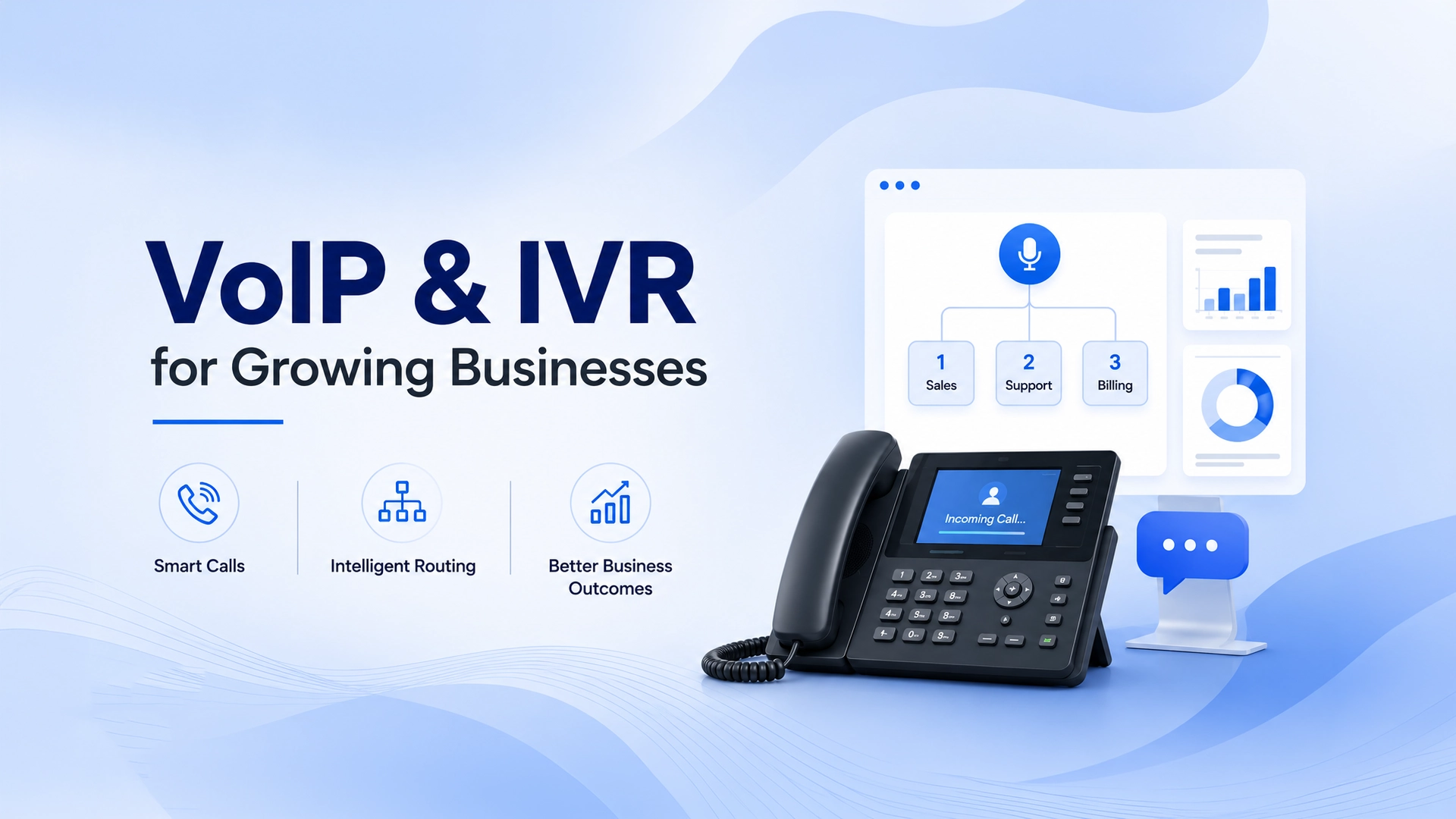
IVR (Interactive Voice Response) is the automated system that greets callers and routes them — “Press 1 for sales, press 2 for support” — or, in more advanced implementations, uses natural language understanding to route calls based on what the caller says rather than forcing them through a menu tree.
Together, these form the backbone of how a business handles inbound and outbound calling at any meaningful scale. The question of whether to buy a packaged solution or build a custom system sits on top of this foundation.
The Case for Buying a Packaged Solution
Packaged VoIP and contact center platforms have matured significantly. For a large share of businesses, buying is the right call.
- Speed to deployment. A packaged solution can be live within days. Numbers can be ported, basic IVR menus configured, and call routing set up without writing a line of code. If you need a working system this month, building from scratch isn’t realistic.
- Lower upfront cost. Monthly per-seat pricing — typically $15–$60 per user per month depending on features — means no large initial investment. For a small team, this is meaningfully cheaper than a custom build in year one.
- Mature feature sets for standard use cases. Call recording, basic analytics, voicemail transcription, standard IVR menus, and CRM integrations with major platforms are all solved problems in mature packaged products. You’re not paying to reinvent functionality that every contact center needs.
- Vendor-managed reliability and compliance. Uptime, call quality, and regulatory compliance (call recording consent laws vary significantly by jurisdiction) are the vendor’s responsibility rather than yours to engineer and maintain.
If your call handling needs are reasonably standard — route by department, record calls, basic reporting — a packaged solution is very likely the right choice, and building custom would be solving a problem that doesn’t actually exist for your business.
When Custom Becomes the Better Investment?
The calculation changes meaningfully under specific conditions.
1. Your call volume has reached real scale
Per-seat and per-minute pricing on packaged platforms is economical at low to moderate volume and becomes expensive at scale. A business running thousands of calls per day, or with a large agent headcount, often finds that the cumulative monthly cost of a packaged platform — sometimes $20,000–$60,000+ per month at scale — would amortise a custom build within 12–24 months, after which the custom system runs at a fraction of the ongoing cost.
This is the same total-cost-of-ownership logic that applies to any SaaS-versus-custom decision: per-seat pricing that felt trivial at 10 users becomes a serious line item at 200.
Real numbers: a 50-agent contact center on a mid-tier packaged platform at $45/seat/month spends roughly $27,000/month, or $324,000/year, indefinitely. A custom-built equivalent might cost $80,000–$150,000 to build and $1,500–$4,000/month to run — meaning the custom system often pays for itself within the first year and saves substantially every year after.
2. Your call routing logic is genuinely distinctive
Standard IVR menu trees work for standard businesses. If your call routing needs to incorporate business logic that’s specific to how you operate — routing based on a customer’s order history, their account tier, real-time inventory or appointment availability, or a proprietary scoring model that determines call priority — packaged IVR systems will require significant workarounds, and some logic simply can’t be implemented within their configuration constraints at all.
A custom IVR can pull live data from your actual business systems — your CRM, your inventory database, your booking calendar — and make routing decisions based on real-time information rather than a static menu structure.
3. You need deep integration with proprietary internal systems
Packaged platforms integrate well with major CRMs and common business tools through pre-built connectors. If your operational backbone is a custom-built internal system — which is common for businesses that have already invested in custom software for their core operations — packaged VoIP platforms often can’t integrate cleanly, forcing manual workarounds that undermine the entire point of automating call handling.
4. You’re building a product, not running internal operations
If voice or IVR functionality is something you’re embedding into a product you sell to customers — a booking platform with built-in calling, a telehealth product with integrated voice consultations — this isn’t an internal tooling decision at all. It’s product development, and custom build (typically on top of a VoIP infrastructure provider like Twilio or Vonage’s API layer, rather than from absolute scratch) is the only real option.
The Middle Path: Build on Infrastructure, Don’t Reinvent It
“Custom” doesn’t mean building telecom infrastructure from the ground up — that would be irrational for almost any business. The realistic custom path uses a communications infrastructure provider (Twilio, Vonage, Plivo, and similar platforms) as the underlying voice and SMS layer, and builds custom application logic — the IVR flow, the routing rules, the integration with your business systems, the reporting dashboard — on top of that infrastructure.
This middle path captures most of the benefit of custom development — tailored logic, deep integration, cost efficiency at scale — without the unrealistic burden of managing telecom infrastructure, call quality, and regulatory carrier relationships yourself. Nearly every “custom VoIP system” built by a software development partner today is built this way.
A Practical Decision Checklist
Work through these questions honestly before deciding:
- What’s your current and projected call volume? Under roughly 20-30 agents, packaged solutions are almost always more cost-effective. Above that, model the actual numbers — don’t assume.
- Is your routing logic standard, or does it depend on real-time business data? If it’s the latter, packaged IVR will frustrate you regardless of how much you configure it.
- Does your core operational system integrate well with major packaged platforms? If you’re already running custom software for operations, check integration compatibility before assuming a packaged platform will connect cleanly.
- What’s the real cost of packaged pricing at double your current volume? Per-seat and per-minute pricing that looks reasonable today can become a serious line item as you grow — model this explicitly rather than discovering it later.
- Is voice/IVR functionality something you’re selling, or something you’re using internally? Product-embedded voice functionality is a different decision than internal call center tooling.
Frequently Asked Questions
1. How much does a custom VoIP/IVR system cost to build?
A focused custom IVR and call routing system built on infrastructure like Twilio typically costs $25,000–$80,000 depending on routing complexity and the number of integrations required. A full custom contact center platform with agent dashboards, reporting, and deep CRM integration can range from $80,000–$200,000+ for larger deployments.
2. How long does a custom VoIP/IVR build take?
A focused IVR and routing system typically takes 8–14 weeks from discovery to deployment. Larger contact center platforms with agent tooling and reporting dashboards usually take 4–7 months, often delivered in phases so basic call handling is live early while more advanced features are added incrementally.
3. Can a custom system still integrate with our existing CRM?
Yes — this is one of the main advantages of custom development. Whether your CRM is a major packaged product or a custom-built internal system, a custom VoIP/IVR build can integrate directly through APIs, often more cleanly than a packaged communications platform’s generic connector would.
4. What happens to call quality and reliability with a custom build?
Because custom builds run on top of established infrastructure providers like Twilio or Vonage rather than reinventing the telecom layer, call quality and uptime are backed by the same enterprise-grade infrastructure that powers many packaged platforms. The custom layer sits in the application logic, not the underlying voice transport — so reliability is not a meaningful trade-off.
Making the Right Call
For most businesses below a certain scale, with reasonably standard call handling needs, a packaged VoIP or contact center platform is the right answer — fast, affordable, and well-supported. The decision tips toward custom when call volume reaches genuine scale, when routing logic depends on real-time business data a packaged product can’t access, or when voice functionality is part of a product you’re building rather than an internal tool you’re using.
Luminous Labs builds custom VoIP and telecom solutions — including our own VoiceNimble platform — for businesses that have outgrown packaged communication tools. If your customer engagement bottleneck is more about chat than calls, our guide to WhatsApp Business automation covers the messaging side of the same problem. Book a free discovery call and we’ll help you model the actual numbers for your specific call volume and routing requirements before you commit either way.
Luminous Labs is an independent software development and consulting company serving businesses globally since 2017, building custom communication systems including VoIP, IVR, and automated voice solutions.